
What does a Flutter developer actually do on a first app?
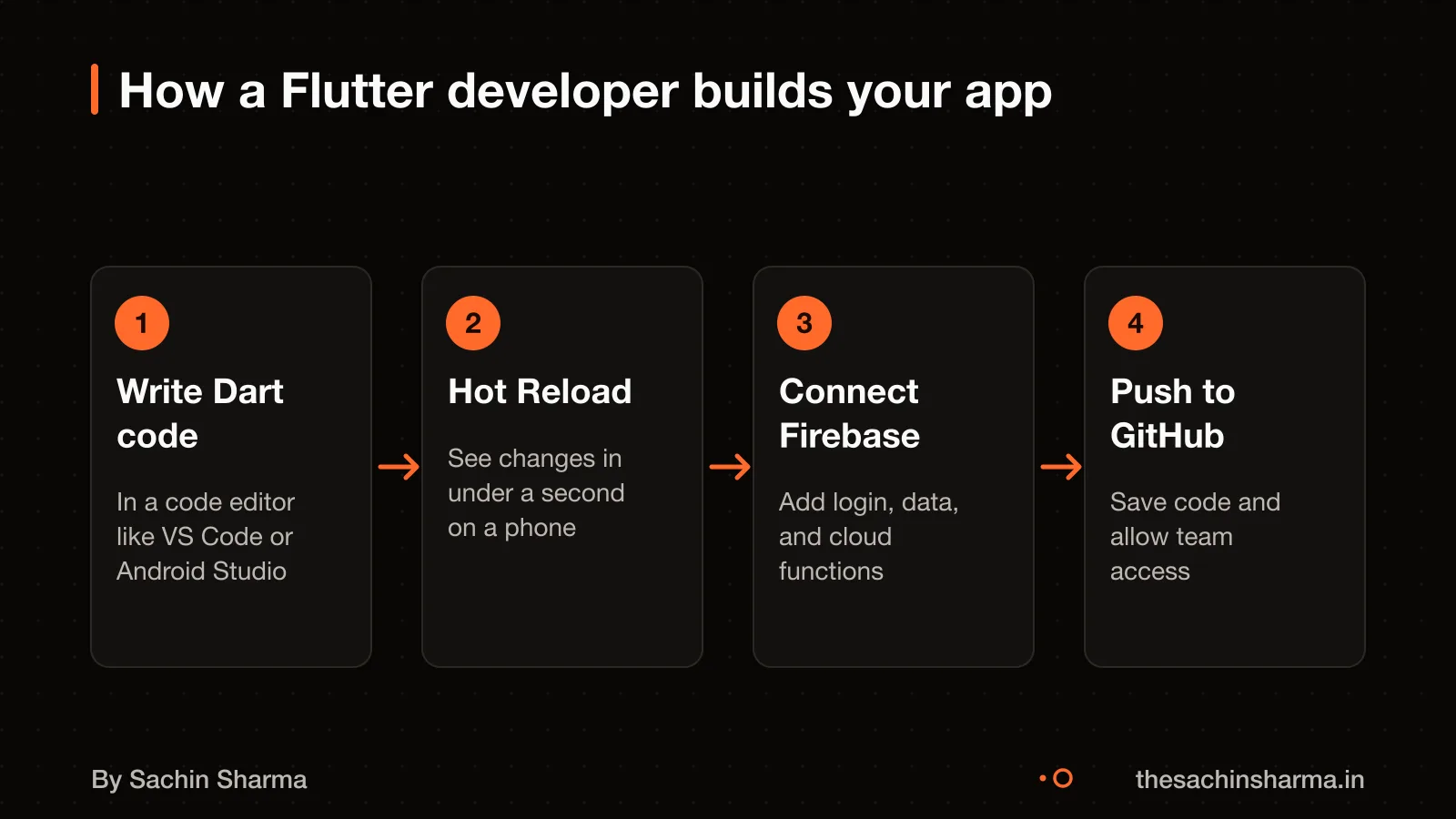
A Flutter developer writes Dart code to build your app, uses Hot Reload to test changes instantly. Connects tools like Firebase for features such as user accounts and cloud storage. They start by planning the app’s structure, then write code in Dart, the language Flutter uses. As they work, they use Hot Reload to update the app live, without restarting it. Changes appear in seconds and the current screen state stays intact. This speeds up fixing bugs and tweaking the design. The developer also sets up backend services like Firebase, which handles user login, real-time data, and file storage. For example, in *Aashwasan*, Firebase stored gig worker profiles and job records. They also connect other Google services like Google Maps or Google Pay when needed. A Flutter developer follows best practices for app architecture, such as separating data logic from the user interface. The app stays easy to update later. In *Loopin*, this meant storing habits locally with Hive and syncing to Google Drive. They also fetch data from the internet safely and display it in the app. You can see how we build offline-first Flutter apps with real decisions from past projects how we build offline-first Flutter apps.
Is Flutter the right choice for your first app?
Flutter can save you 30 to 40 percent in cost compared to building separate native iOS and Android apps. This happens because one codebase works on both platforms, cutting development time and effort. It is a strong choice when your app needs to run on mobile and you want to move fast with a limited budget.
However, native development might be better if your app uses advanced device features like AR, complex animations or deep OS integration. Flutter may not support the latest native APIs right away. For most first apps, such as forms, lists, and simple workflows, Flutter is more than capable.
Flutter supports mobile (iOS and Android), web, and desktop from a single codebase. This means you can expand to new platforms later without rewriting everything. It compiles to fast machine code on devices and runs as JavaScript on the web, ensuring good performance. Google backs Flutter, and big brands use it, so it is not going away.
If you want a single app that works across platforms and keeps costs low, Flutter is likely the right choice. For apps that demand the highest performance or latest device features, native could be better.
Learn more about native or cross-platform: which one for your app?
How much does it cost to hire a Flutter developer?
As an estimate, assuming global rates apply in India, a simple MVP or internal app costs $5,000 to $25,000. A typical business app with standard features costs around $50,000. A SaaS or enterprise app costs $80,000 to $250,000. These figures are in USD and based on international data, as India-specific hiring costs are not published.
Three main factors increase cost: more screens, complex features like real-time sync or payments, and third-party integrations. Apps that need admin panels, user roles, or offline sync also cost more. You pay more if the developer uses custom designs or advanced state management.
Hourly rates vary by experience and region. In North America, senior Flutter developers charge $150 to $200 per hour. Experienced developers globally may charge $61 to $80 per hour, as of early 2025. Milestone pricing is common for fixed-scope projects. It sets a total price broken into payments at key stages, like design complete or beta launch.
Hourly pricing gives flexibility but needs close tracking. Milestone pricing controls cost but may not allow changes once started. Your contract should define what each milestone delivers. For a clearer breakdown of costs, see what does a Flutter app cost?.
How long does it take to build a first Flutter app?
As an estimate, a simple MVP takes 1 to 3 months. A B2C or eCommerce app takes 3 to 6 months. A SaaS or enterprise app takes 5 to 9 months. These timelines assume a clear scope, no major changes during development, and timely feedback from you.
Delays happen when requirements change mid-project, approvals take long, or key features are added late. For example, adding real-time sync or payment processing after coding starts can add weeks.
To stay on track, finalise your core features before development begins. Review progress every two weeks. Use simple tools like a shared checklist to confirm what is done.
Timelines are based on general industry data as of 26 January 2026 and may vary by team and location. India-specific data is not available in the evidence.

What technical decisions does a Flutter developer make?
A Flutter developer separates the user interface from business logic so changes do not break core functions. They keep the UI layer clean by ensuring views do not contain business rules and only display data passed from a view model. This one-to-one link between view and view model defines each feature clearly.
They use use-cases to isolate complex actions like processing a legal document or syncing user data. This makes testing easier because logic runs independently of screens. In Legease, a Flutter AI legal-document platform, use-cases handle document analysis.
Architecture is not rigid. While separation of concerns improves maintainability, a developer adapts the structure based on your app’s needs. They follow guidelines, not strict rules, to balance speed, cost, and long-term growth. You benefit when they adjust rather than copy a fixed pattern.
See how Legease uses Flutter and AI how Legease uses Flutter and AI to manage real-world complexity with clean code.
Who owns the code and what must be in the contract?
You do not automatically own the code just because you paid for it. The Flutter developer retains copyright by default, even if you funded the work. This is because software created by an independent contractor is not considered "work made for hire" under copyright law, unless a contract says otherwise. Without a written agreement, you may only have an implied license to use the app, and the developer could legally claim ownership.
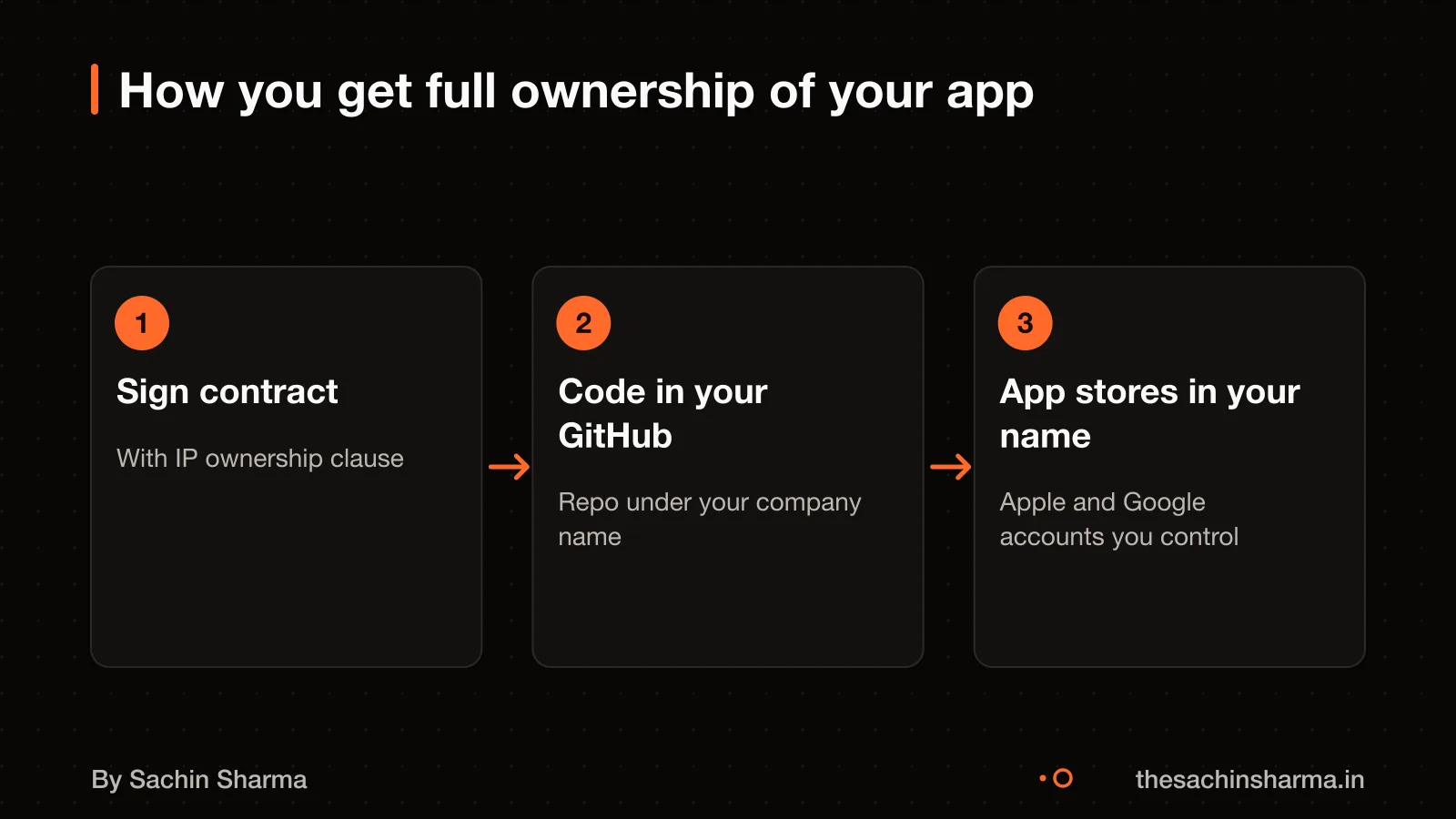
To protect yourself, the contract must include an explicit clause that assigns full copyright of the source code to you. This ensures legal ownership transfers from day one. The contract should also state what code, documentation, or assets you should expect to receive and own at the end. A written development contract is essential, it is your best way to secure your app’s intellectual property.
The source code should be stored in a repository under your control, such as a private GitHub or GitLab account that you own. App store accounts (Google Play and Apple Developer) must also be in your name, not the developer’s. This prevents lock-in and ensures you can switch developers or update the app later. I work directly with clients and help set up ownership correctly from the start. For more on how we protect your ownership from day one, see how we protect your ownership from day one.
How to verify a Flutter developer’s work
Ask to see a live app or a video demo of a full feature flow from their past work. A shipped app shows they can finish and launch, not just code. If they worked on a team, ask which parts they built. A clear answer means they own their work.
Check their written communication early. Send a short message asking for a 15-minute call or a written update. Clear, prompt replies show they can work in a remote team. Poor replies now mean bigger problems later.
In your first meeting, ask: “What was the hardest part of your last project?” and “How did you handle a scope change?” Their answers show problem-solving style and honesty. Also ask for a one-page scope document they’ve written. It proves they plan before coding.
A written scope should list features, tech choices, timelines, and what is not included. If they cannot share one, that is a red flag.
Want to know what three questions to ask in your first call? Send me your app idea and I will reply with the exact questions to ask.
Message me on WhatsAppHow to check progress during development
A written development contract is important for owning the app’s code. You can confirm the app behaves as expected before more time is spent. Code and feature reviews should happen at each milestone, not just at the end, so you can catch mismatches early. Written communication is key, especially if the developer is remote, so updates should be clear, frequent, and in plain language. This keeps surprises low and trust high.
When this advice is wrong
- You do not need a Flutter developer if your goal is a basic website with text, images and contact forms. A simpler web builder or WordPress site costs less and is faster to launch. Consider this if your users mostly browse on phones but do not need offline access or app-store presence.
- If your budget is under ₹5 lakh and you do not need offline use. Real-time sync or complex interactions, a no-code tool like Glide or Thunkable may be enough. These let you build app-like experiences without code, though they limit custom design and performance.
- If you already have a technical team or a founder who codes, building in-house may give you more control and lower long-term costs. This works best when your app needs frequent updates or deep integration with internal systems.
Next step: message me on WhatsApp with what you want to build. No forms, no sales team.
Message me on WhatsAppYour checklist
Before the first call, here is what to check, in the order it hurts to skip. Tick what you have verified; the page tells you where you stand.
Proof
Process
Ownership
Money
Walk away if
- Quotes only a total with no scope
- Won't say who writes the code
- Asks for the whole payment up front
- Keeps the store accounts or repository
- Promises a fixed date without seeing a scope
Questions people ask
01What does the engineer actually decide on a first Flutter app?
The engineer decides on a clean architecture with separate UI and data layers. They ensure views contain no business logic and pair each view with one view model. This keeps the code maintainable and testable as the app grows.
02Which skills matter most for a Flutter developer?
Strong Dart coding and Firebase integration skills are essential for technical delivery. Clear communication and teamwork also matter, as poor soft skills can delay projects.
03How do I test a developer’s technical skills if I’m not technical?
04What are the hidden costs in Flutter development?
Web support adds 20 to 30 percent to a mobile-only app’s cost. Each desktop platform adds $8,000-$15,000 to the cost of a Flutter app, and each third-party tool like payments or maps adds $1,000-$5,000.
05Should I hire a freelancer or an agency?
06What happens after the app launches?
07How do I handle scope changes during development?
08What are the tax implications of hiring a developer in India?
If your annual turnover is ₹500 crore or more, you must issue GST e-invoices from 1 October 2020. Tax audit reports are due by 30 September 2026. Check this for your case with a chartered accountant.