What kinds of app development teams are there in India?
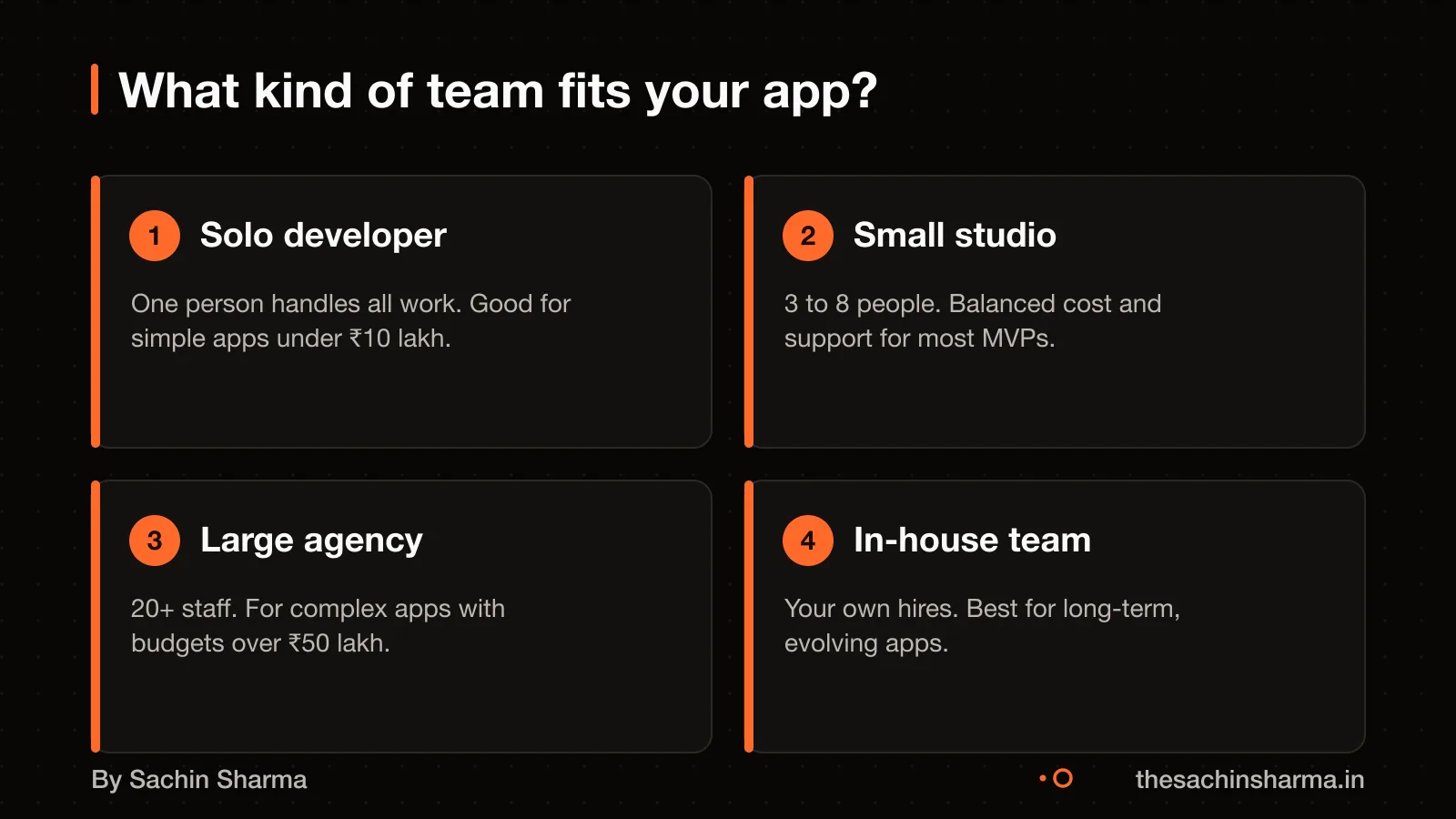
The four main types are solo developers, small studios, large agencies, and in-house teams. A solo developer is one person who handles design, coding, and testing. Often at the lowest hourly rate but with more direct management needed from you. This fits simple apps under ₹10 lakh, such as a basic utility or content app. A small studio (5 to 20 people) usually includes a project manager, QA, and support. Making it ideal for a typical MVP that needs structure and faster iteration. A large agency (100+ staff) has specialists like Frontend Developers, Backend Architects, and Mobile App Builders. Works best for complex, regulated systems such as multi-tenant platforms or AI-heavy products. In-house means hiring your own team, which gives full control but takes longer to set up and scale. For a startup, the best fit is often a small studio or a skilled solo developer, depending on your need for oversight and speed. Teams in Bengaluru, Hyderabad, Pune, and Delhi NCR have the highest concentration of mobile talent in India.
The best kind of app developer for a startup
How much does each type cost for an MVP?
An MVP built in India costs 60 to 75 percent less than in the US or UK. Where the same app runs $80,000 to $200,000. For you, this means a solo developer may charge ₹18 to ₹40 lakh for an MVP. Small studios typically quote ₹30 to ₹70 lakh. Large agencies often ask ₹70 lakh to ₹1.5 crore or more. These are estimates based on US/UK baselines and the 60 to 75% saving.
Cross-platform development with tools like Flutter or React Native can cut total build cost by up to 40 percent. This is because one codebase works on both Android and iOS, nearly halving the effort. For example, a ₹50 lakh native-only project might cost ₹30 lakh if built cross-platform, assuming 40 percent savings.
Hourly rates in India vary: junior developers charge $10 to $18, mid-level ones $20 to $35. Solo developers often bill hourly, while studios and agencies prefer fixed quotes. Sharing your budget range helps them tailor the scope.
Want a number for your idea? Send one line on WhatsApp. I reply with what drives the cost and what to cut.
Message me on WhatsAppHow long does each type take to deliver?
A typical app MVP takes 3 to 4 months to deliver, based on Sachin's project experience. This timeline assumes a clear scope, active feedback and no major changes during development. Solo developers may start faster but depend on one person’s availability. Small studios balance speed and support, often delivering within the 3 to 4 month range. Large agencies follow strict processes, which can extend time due to approvals and handoffs.
Delays most often come from unclear requirements, slow feedback or scope changes. Some infrastructure contracts allow up to 42 months for completion, which is not typical for standard apps. This is not typical for standard apps and likely covers complex infrastructure. What slows down each team type is not documented [unknown]. Always state your launch deadline and its business reason when briefing the team.
Who owns the code by default?
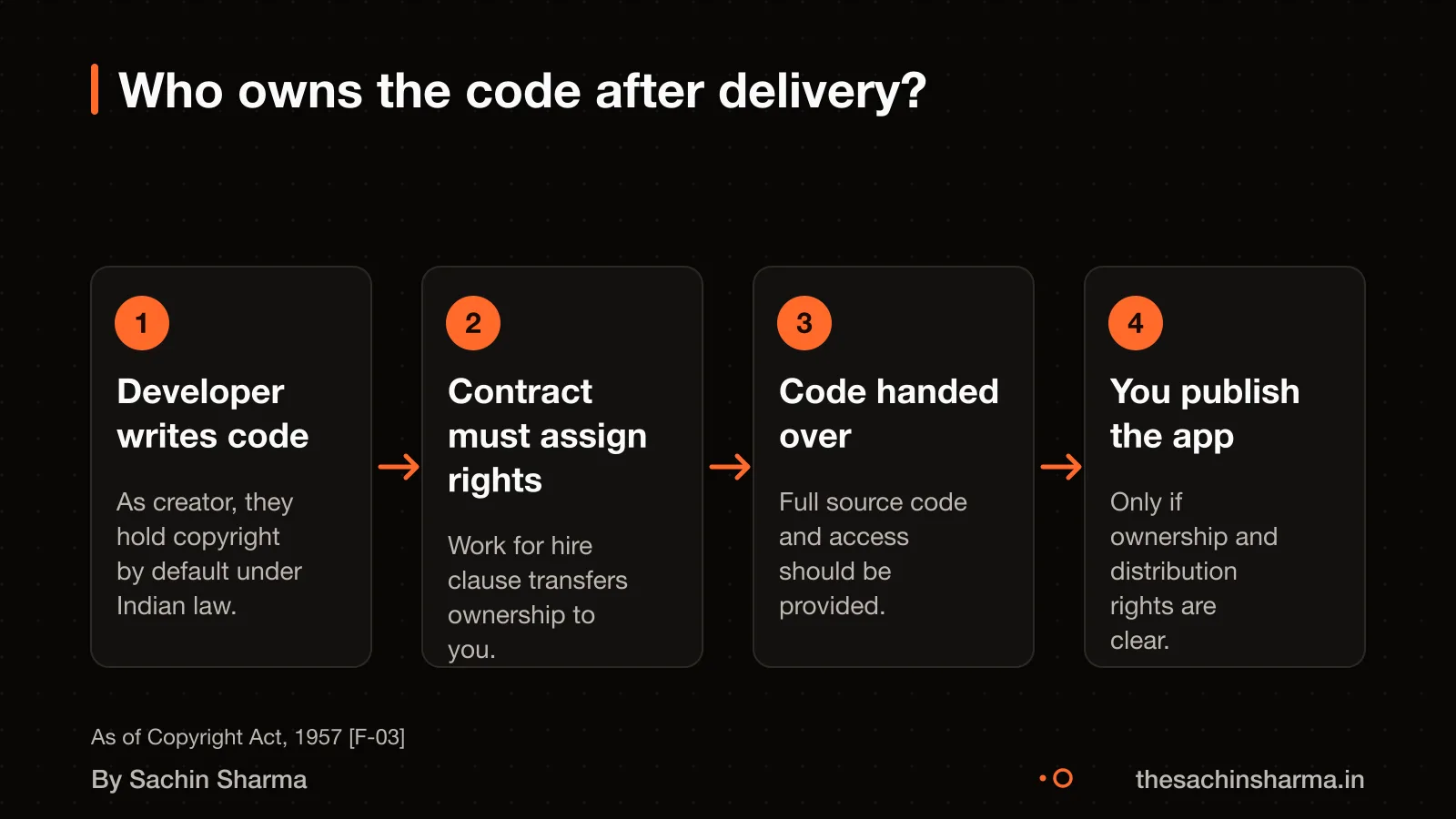
By default, the developer owns the code unless your contract says otherwise. Under India's Copyright Act, 1957, copyright subsists in original literary works, which includes software code. Since code is treated as a literary work, the person who writes it holds the copyright at first.
To get full ownership, your contract must include a 'Work for Hire' clause. This clause transfers all rights from the developer to you. Without it, even if you paid for the app, the developer legally owns the code and can reuse it for others. A clear agreement ensures you own the custom code, designs and documentation made for your project.
Some firms, like Tibicle LLP and ValueCoders, state they provide full IP handoff and source code ownership at project close. But do not assume this is standard. Always confirm the contract includes a written assignment of IP rights to you. For full control, the contract should say the work is "made for hire" and that all rights are transferred to you upon payment.
Open source tools, like REI3, let you build and run the software as you wish, with access to the source code. But this applies only to the tool, not your app. Your app’s ownership depends on your developer contract, not the tools used.
What must the contract include?
Your contract must clearly define the scope, ownership, and exit terms. A good contract protects you if things go wrong and makes success more likely by setting clear expectations. Do not sign one that lacks these.
The key clauses are the scope of work (SOW), intellectual property (IP) ownership, and termination rights. The SOW includes a detailed description of what will be delivered. For example, "user registration with email and OTP" is clear; "build a mobile app" is not. The IP clause includes who owns the code, designs, and documentation when the project is done. Without it, you may not own the software you paid for. The contract includes termination rights.
Red flags include a vague SOW, no IP clause, 100% upfront payment, and no defined deliverables. These increase your risk of disputes, delays, or losing control of your app. A vague SOW leads to mismatched expectations. Upfront payment removes the developer’s incentive to finish. No deliverables mean no shared definition of “done”.
If there is no IP clause, you do not automatically own the code. Under India’s Copyright Act, 1957, the creator holds copyright unless a contract says otherwise. So without a clause, the developer owns the code, even after you pay. You may need their permission to update, scale or move the app.
Termination rights must include three types. Termination for Cause allows either party to terminate for material breach, with a 7 to 14 day cure period. Termination for Convenience lets you stop the project with 30 days’ notice. Upon termination, you must get all completed work.
Have a quote in hand? Send it to me and I will mark what is missing.
Message me on WhatsAppHow does the DPDP Act affect my app?
As the app owner, you are liable for compliance under India's Digital Personal Data Protection Act (DPDP Act). This means you must ensure valid notice and consent are provided in plain language. In at least one of the 22 official Indian languages plus English where reasonable. Consent must be free, specific, informed, and given by a clear affirmative action, such as ticking a box or tapping "I agree".
You must collect and keep only the data necessary for the stated purpose. This is called data minimisation. For example, if your app only needs a phone number for login. Do not also ask for the user’s birth date or location without a clear reason. You must also let users access, correct, and delete their data through built-in tools. Appoint a grievance officer to handle complaints.
Cross-border data transfer is allowed by default. Unless the country receiving the data is on the government’s negative list. As of now, no country has been named on this list. But you must stay updated. The law applies to you if you process personal data of Indian residents. Even if your company is based outside India.
The compliance deadline for major data fiduciaries was November 2025. The Data Protection Board initiated enforcement actions in Q1 2026. Actions have already been taken against apps that lacked valid consent or proper data retention. Fintech, ed-tech, and foreign-headquartered apps have faced more scrutiny. The Data Protection Board enforces the law. It is appointed by the central government. So its independence may vary.
If your app handles Indian users’ data, you must act now. For help designing valid consent flows, see the guide: DPDP Act: consent flows an Indian app actually needs.
How do I verify real shipped work?
Ask for live app store links and install the app yourself to test it. To check technical depth, ask how they solved hard problems like data sync or security. For example, ask how they handled offline mode or payment failures. A strong team explains their choices clearly and in plain terms.
Most Indian mobile app developers can communicate fluently in written and spoken English. You can also ask if they would hire the same team again. If the developer refuses to share contacts or demos, that is a red flag.
See what does it cost to build an app in India? for real project budgets and trade-offs.
What does post-launch support cost?
Post-launch support typically includes a 90-day window to fix bugs and ensure stability under real traffic. This is standard for many development partners in India, including studios like Tibicle LLP. During this period, minor issues found after launch are resolved at no extra cost.
Long-term support beyond 90 days is not included by default. Its cost is not published in available evidence. You will need to negotiate a separate maintenance agreement if you want ongoing updates, feature additions or help with OS upgrades.
If the company shuts down, your ability to continue the app depends on code ownership. Ensure your contract states that you own the source code and have full access to repositories. Without this, you may face delays or legal hurdles.
Moving your app to another team later is possible only if you have full access to code, documentation and third-party accounts. How to handle OS updates and team handovers is not documented in evidence. Ask your current team for a transition plan before support ends.
What fails first under stress?
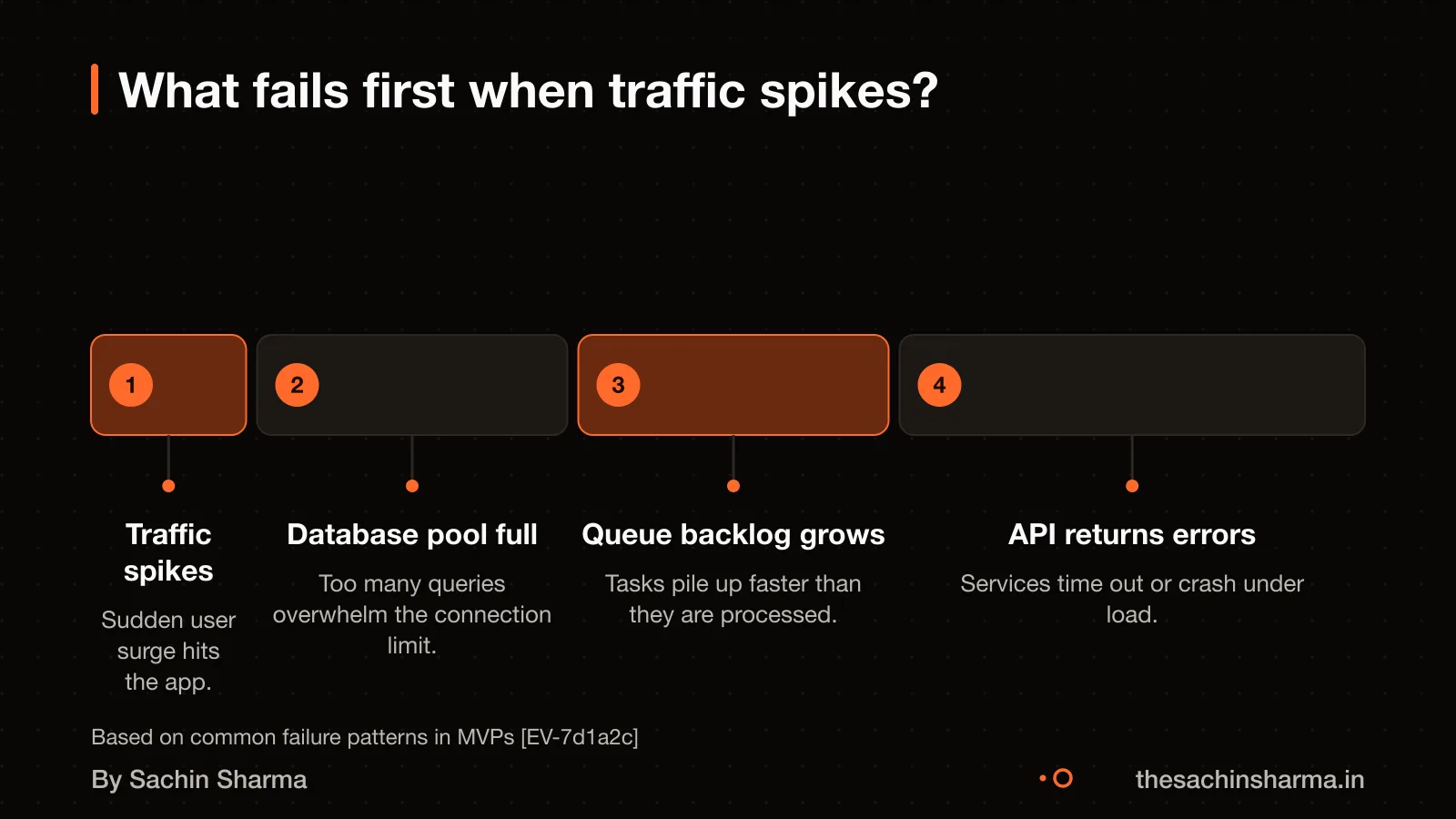
Under heavy traffic, your app’s database connection pool, queue backlog, or a downstream API is most likely to fail first. These shared dependencies can become bottlenecks when too many users act at once. For example, a sudden spike during a sale event may exhaust database connections, causing timeouts even for simple actions.
To find these weak points, run stress tests that simulate real user surges, like a product launch or festival rush. Track latency, error rates, throughput, and resource use together to see not just when things break, but why. A test that shows 500 errors per second without context won’t help you fix the root cause.
Ensure your test environment matches production in hardware, data volume, and network setup. If your live app runs on AWS EC2 with 10,000 user records and Redis caching, your test setup must too. Otherwise, results can mislead and leave real flaws undetected.
Testing this way reveals whether your app recovers after traffic drops, not just when it breaks. Recovery is as important as uptime.
Is in-house hiring better?
In-house hiring is not better for most first-time app builders. It only makes sense if you need full-time, ongoing development and can handle the overhead. For a single developer, in-house hiring can cost ₹15 to ₹25 lakh per year or more, depending on skill level and city.
It makes sense only when your app will need constant updates, new features, or deep integration with internal systems over many months. If you are building a one-off MVP or a simple app, in-house is overkill.
An Employer of Record (EOR) like Wisemonk can help by letting you hire someone compliantly in India without setting up a local company. The EOR handles payroll, taxes, statutory benefits, and labour-law compliance, so you focus on the work. This service starts at $99 per employee per month.
India’s four labour codes, the Code on Wages 2019, the Industrial Relations Code 2020, the Code on Social Security 2020. The Occupational Safety, Health and Working Conditions (OSH) Code 2020, have been in force since 21 November 2025. These laws standardise hiring, wages, social security, and working conditions. You must follow them, either directly or through an EOR.
If you are not ready for long-term hiring, consider a solo developer or small studio instead.
Worked example: cost of a 40-screen MVP
As an estimate, a 40-screen MVP with one payment gateway costs ₹12 to 25 lakh in India.
The lower end of the range (₹12 lakh) assumes heavy use of cross-platform development and a lean team structure. The upper end (₹25 lakh) allows for more native features, integrations, and mid-level developer rates.
For example, if the full US cost is $100,000, a 70 percent saving brings it to $30,000. That is about ₹22.5 lakh at ₹75 per dollar. A further 40 percent saving from cross-platform use could reduce it to $18,000. That is about ₹13.5 lakh. This shows how team choice and tech stack directly affect your cost.
These numbers are estimates based on 2026 data. Actual costs depend on feature complexity, design quality, backend needs, and how often you change the scope.
When this advice does not apply
In-house hiring only makes sense if you have enough work to fill a full-time role for at least a year. Setting up payroll, contracts and benefits under India’s labour codes takes time and cost, even with an EOR. As of 21 November 2025, the four national labour codes are in force, covering wages, social security, industrial relations and occupational safety. Using an EOR like Wisemonk has pricing from $99 per employee per month.
A solo developer can be enough for a simple app, like a brochure site. Basic tool or internal workflow, if you accept slower progress and direct management. However, if your app needs multiple skills (design, backend, DevOps) or fast turnaround, a solo worker may become a bottleneck.
Sometimes, you should not code at all. Off-the-shelf tools like Shopify, Zoho or Google Forms may solve your problem faster and cheaper than a custom app. This advice does not cover no-code options, as evidence is not provided.
Related reading: What does it cost to build an app in India?, Best way to build a quick commerce app.
Next step: message me on WhatsApp with what you want to build. No forms, no sales team.
Message me on WhatsAppWeigh what matters to you
I won't name a number one, because the best depends on what you weigh. Set what matters and see which kind of team fits.
- 1Solo developer3.8
- 2Small studio3.8
- 3Large agency3.5
- 4Hire in-house3.5
Scores are general tendencies for each kind of team, set out as a starting point. They are not ratings of any named company.
Whoever you pick: checks, in the order they save you
- Open two of their shipped apps on your own phone.
- Ask who will write the code, by name.
- Get the scope, and the not-included list, in writing.
- Ask for milestones you can test.
- Confirm the repository and store accounts are in your name.
- Speak to a past client.
- Ask what happens if you stop midway.
- Ask how changes are priced.
- Ask what the first month after launch costs.
- Compare the assumptions in quotes, not the totals.
Questions people ask
01How does timezone overlap affect delivery?
India typically has 4 to 5 hours of overlap with US teams and European teams. This makes real-time collaboration possible without either side working late hours. Plan meetings during this window for faster decisions.
02What should I include in a project brief?
Your brief should state the problem and who faces it. List must-have features, platform preference, budget range, and reference apps with notes on what you like. Vague briefs produce variable quotes.
03What should I check in a developer's portfolio?
A good agency will ask clarifying questions after reviewing the brief. A strong developer asks clarifying questions after reviewing the brief.
04What if I need to change scope during development?
Vague language in contracts can lead to disputes when expectations don't match what's delivered.
05What are red flags in a contract?
Avoid contracts with no IP ownership clause, as you may not own the software you paid for. Also watch for 100% upfront payment, which removes incentive to deliver, and undefined deliverables, which leave 'done' unclear.
06Can I move my app to another team later?
This depends on your contract terms, access to source code, and documentation quality. Without clear ownership and handover terms, switching teams can be hard. Check this for your case with a software lawyer.
07What happens if the developer shuts down?
If the developer stops working, your project could stall unless your contract includes code handover and backup plans. Ask about these before hiring. Check this for your case with a legal advisor.