
What you are actually choosing between
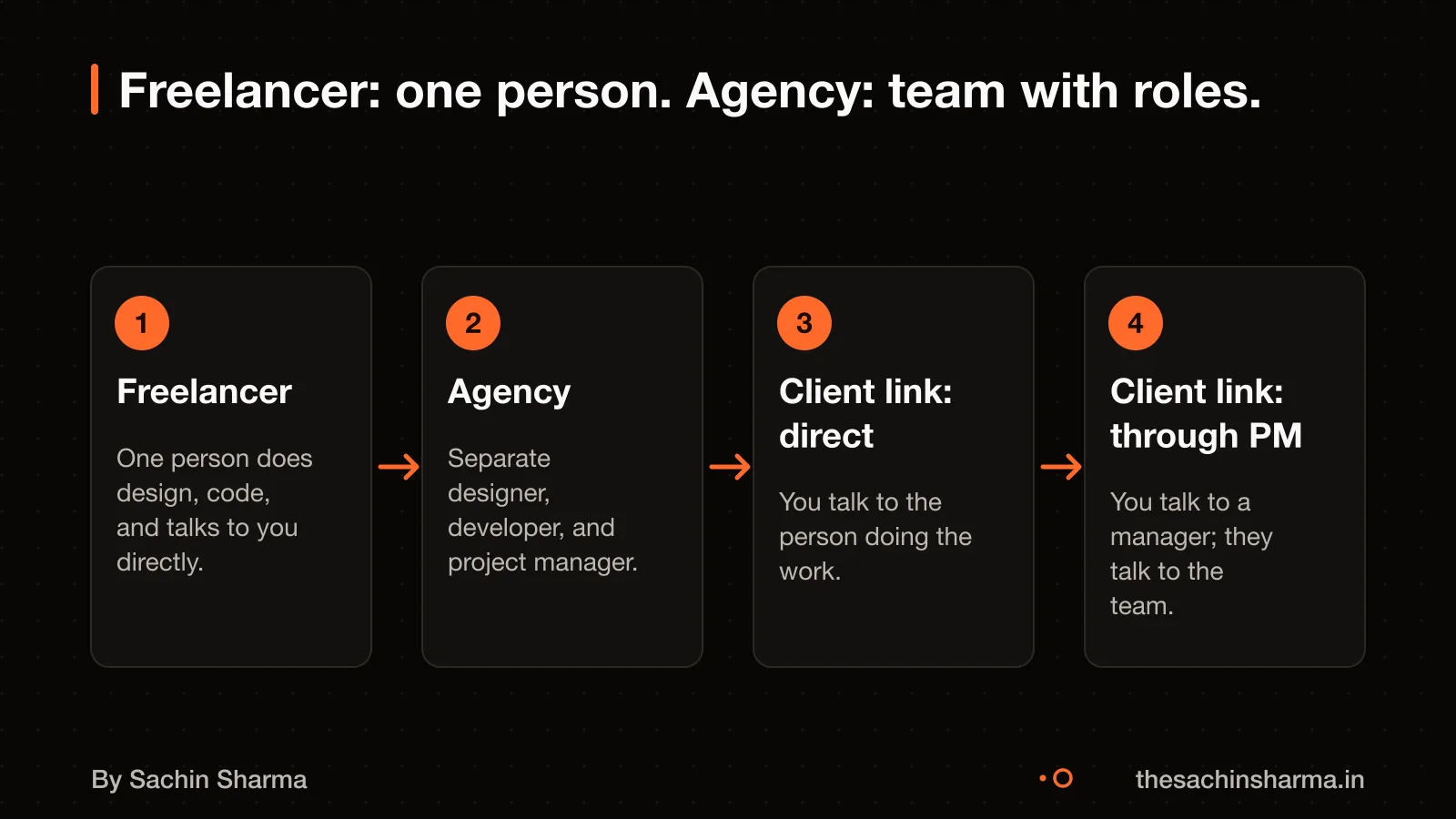
You are choosing between one person and a full team. A freelancer is cost-effective and flexible but may lack consistency and scalability. You talk directly to them, make changes fast, and pay less upfront. But they can only do one thing at a time, and their skills may not cover design, testing or complex backend work.
An agency gives you a team: designers, developers, project managers and QA testers all working together. They follow set processes, which makes delivery more reliable. You do not talk to the coder directly, the project manager handles updates and planning. This adds structure but can slow down small changes.
For a first app, this choice decides how much control you want. With a freelancer, you lead the project. With an agency, they guide you. Each works well only when your needs match their shape.
When each model wins
A freelancer is ideal when your project is under ₹1,00,000 and has a clear scope. A well-defined scope reduces risk because freelancers work best on tasks you can describe in one page, like a landing page or API integration. If your budget is tight, a freelancer may suggest cutting features to stay within cost, focusing only on what’s essential.
An agency is better for complex projects needing design, development, testing, and long-term support. If your app requires multiple skills at once, like UI/UX, backend, and QA, an agency’s full team lowers coordination risk. Agencies are suitable for projects priced at $50,000+ where structured delivery and senior oversight are needed.
Agencies are ideal for complex, long-term, or large-scale projects that require a team and structured processes.
how to hire a Flutter developer for your first app mobile app development services
Cost comparison: what the numbers say
Indian freelancers charge ₹500 to ₹5,000 per hour. For a first app with a clear scope, this makes freelancers cost-effective if your total budget stays under ₹1,00,000. In contrast, agencies may start at $30,000 for fixed-scope MVPs. So if your budget is tight, hiring an Indian freelancer gives you more control over costs. But if you need multiple skills at once, like design, backend, and compliance, an agency may justify its higher price.
The real cost difference is not just in hourly rates. It is also in how work is managed. A freelancer may take longer if they juggle other clients. An agency assigns dedicated teams but adds overhead. As an estimate, a 200-hour project at ₹1,250/hour totals ₹2,50,000. This is within range for a skilled Indian freelancer. It is below an agency’s minimum.
what you actually pay for
Want a number for your idea? Send one line on WhatsApp. I reply with what drives the cost and what to cut.
Message me on WhatsAppTime to deliver: when can you start and launch?
A freelancer can start in 1 to 3 days. The quote for agencies mentions 1 to 2 weeks for speed to start. This delay comes from agency processes like team allocation, contract reviews, and project kick-offs. Which slow the start but aim to align with long-term goals. For your first app, if speed matters, a freelancer gives you faster access to development time.
Simple projects take 2 to 4 weeks to complete, while mid-market projects with custom theme work take 4 to 8 weeks. A simple app might be a static website or a basic mobile app. A complex app could include login systems, payment gateways, real-time sync, or AI features.
If your idea is ready and you want to launch fast, a freelancer shortens the gap between decision and delivery. An agency’s slower start may still deliver faster overall due to parallel work. The key is matching the model to your project’s scope and your own ability to manage progress.
Worked example: a ₹1,00,000 app
Worked example: a ₹1,00,000 app
As an estimate, a freelancer might charge ₹70,000 for a clear-scope app that takes 50 hours at ₹1,400 per hour. This assumes the scope is fully defined and no major rework is needed. The hourly rate falls within the ₹500 to ₹5,000 range seen in India for skilled freelancers.
An agency might charge ₹1,20,000 for the same app, assuming conversion from $30,000 at ₹80 = $1.
Agencies bundle roles like designer, developer, QA, and project manager, and their pricing reflects team effort and process. Freelancers charge for time and skill with lower overhead. The freelancer model may save money if you can manage coordination and accept limited backup. The agency model may cost more but could reduce your management load and risk of delays.
Assumptions: - Freelancer rate: ₹1,400/hour (within the ₹500 to ₹5,000 range) - Effort: 50 hours for a well-scoped app - Agency MVP baseline: $30,000 - Exchange rate: ₹80 = $1 - App complexity: Fits within a freelancer’s upper limit of ₹1,00,000
Risks of hiring a freelancer
The main risk of hiring a freelancer is dependence on one person. If that person becomes unavailable, there is no backup. This is known as a high *bus-factor risk*, the chance that your app's progress stops if the developer leaves or disappears. Unlike agencies, there is no team to step in.
Quality varies depending on the individual. You must vet each one carefully, as skill levels differ. A strong portfolio and clear communication help, but there is no standard guarantee. Some marketplaces offer dispute resolution, but they rarely ensure project continuity if the freelancer quits.
If the freelancer disappears, accountability falls to you. You will need to find someone new, recover the code, and close the knowledge gap. This can delay your launch or increase costs. Even with version control, undocumented logic can be hard to rebuild.
If your app stalls, you may need to rescue a failed or abandoned app. This often means paying again to fix or restart.
Risks of hiring an agency
Agency-owned accounts are a single point of failure for your app. If the agency controls your cloud backend and shuts down their account, your APIs. Databases and authentication all go offline, breaking the app for users. This means your business can stop working not because of your own actions, but because of a vendor’s decision or oversight.
Transferring ownership without the agency’s consent can be slow or blocked. In practice, some businesses have been locked out for weeks while negotiating access, especially if the agency is uncooperative. Even if you own the code, the live system may be trapped in their cloud account, making migration costly and risky. As a result, parts of your app may need to be rebuilt from scratch to regain control.
To protect yourself, ensure your contract requires that all cloud accounts, including AWS, Firebase, or Google Cloud. Are either owned by you from day one or transferred fully before launch. Do not rely on shared access. Temporary access ends when the project does, but your app must keep running.
Ownership and legal protection
You should ensure your contract assigns full intellectual property rights to you and that you hold the credentials. As vendor policies treat the account holder as the owner. Without this clause, the developer or agency may retain ownership, even if you paid for the work.
This means if your agency holds the Apple Developer Account, they control app updates, distribution and removal, not you. The same applies to cloud resources like databases and APIs.
If the developer or agency shuts down, you risk losing access to your app unless you own the accounts and have all credentials. A freelancer who disappears may lock you out just as much as an agency. To protect yourself, require that all accounts, developer, cloud, domain, are created under your name or transferred to you before final payment.
For example, if you hire someone to build a Flutter app, you should own the Google Play Console account or have full admin access. The same goes for Firebase, AWS, or any backend service. Store signing keys and API credentials in your own password manager.
A strong contract must state that the app, source code, design files, and all associated accounts and keys are your property. This is non-negotiable. Do not proceed without it.

Contractual safeguards you must include
Your freelance contract must clearly state the service description, pricing, and intellectual property (IP) rights to protect both you and the developer. A contract outlines each party's rights and obligations. Include a detailed list of deliverables, such as app features, design files, and source code handover. This avoids confusion later.
Pricing must be specified as either a fixed project fee or an hourly rate, with payment milestones tied to deliverables. This ensures you only pay for work completed. A contract may be terminated by novation or rescission. A promisee may dispense with performance of a promise.
If work stops, your rights depend on the contract terms. You may pause payments, request a handover of completed work, or hire someone else to finish. Always insist on full IP assignment in writing so you own the app code, design, and data once the project ends. Without this clause, the freelancer may legally retain ownership.
How to verify claims before hiring
Check if a developer can deliver by asking for a live demo of a shipped product. A working app proves they can finish and launch. Avoid vendors who only show mockups or promises.
Ask for proof such as code samples, client references, or a GitHub repository. The Bubble.io landscape includes a handful of established and reputable vendors and a long list of fly-by-night outfits. For agencies, verify team size by requesting names and roles of assigned members. If they refuse, treat it as a red flag.
Spot unreliable vendors by checking if they charge for up-front scoping. They should include discovery in the cost, not bill it separately. Also, be wary of vague timelines or unwillingness to define deliverables clearly.
Spot scope creep in a quote by looking for open-ended terms like "and more" or "unlimited revisions". Every task should be listed with clear boundaries. A fixed-price quote with itemised features is safer than hourly estimates with loose descriptions.
Verify past work through independent sources. If they claim a project is live, visit the site yourself. For added trust, use a system like Cascrow, where three of five must agree that a delivery is complete.
Have a quote in hand? Send it to me and I will mark what is missing.
Message me on WhatsAppWhen this advice does not apply
When this advice does not apply
Do not hire a freelancer if your app handles sensitive personal data, such as health or financial records. One person may lack the legal and security setup to protect you.
Do not hire an agency if your budget is under ₹1,00,000 and your scope is narrow, like a single-feature MVP or landing page. Agencies have overheads that push costs higher, and their standard contracts may not fit small projects.
Starting with a freelancer may make it harder to hand over code to a team, as documentation and structure can vary.
Next step: message me on WhatsApp with what you want to build. No forms, no sales team.
Message me on WhatsApp
Pick your situation
I am a solo developer, so I benefit from the first answer. That is why the table below also tells you when an agency is the better pick.
Pick your situation
Freelancer wins. Nothing is lost between a salesperson and the person writing code. A clear scope is the case where one skilled person is fastest.
The whole comparison
| Freelancer | Agency | |
|---|---|---|
| Who writes the code | The person you speak to | Often someone you never meet |
| Cost shape | Day rate or fixed price, little overhead | Higher rates carry the team and process |
| Time to start | Quick, if they have capacity | Slower to staff, steady once started |
| Main risk | One point of failure | Hand-offs and who is really on it |
| Breadth | Deep in a few things | Many specialisms available |
| Accountability | One name | A company and a contract |
Whichever you choose, ask these
- Who exactly will write my code?
- What happens to my code if we stop midway?
- What is not included?
- What does support cost after launch?
Questions people ask
01What is the cost to migrate a freelancer-built app to an agency later?
As an estimate, assuming undocumented code and no handover, migration can cost $8,000 to $50,000. This range depends on code quality, access to source, and documentation. If the freelancer left clean, tested code in your repository, costs may fall. Check your contract for ownership terms.
02How do I verify a freelancer's actual coding ability beyond their portfolio?
Ask for a small paid task on a real feature you need, review their code for structure and comments, or use a third-party audit tool. As a developer, I focus on clean logic and maintainable code. Sachin Sharma is a software developer in India who works with Flutter and full-stack apps. Avoid tasks that waste their time.
03What happens if the freelancer disappears mid-project and how can I protect myself?
You are responsible for recovery, re-hiring, and bridging the knowledge gap. Marketplaces may help with disputes but rarely guarantee continuity. Protect yourself by keeping code in your GitHub, requiring handover docs, and adding a kill clause in the contract.
04Can I hire a freelance developer just for ongoing maintenance?
Yes, if the scope is clear and communication is structured. Define response times, update types, and limits on changes. Link to maintenance pages for templates and checklists to avoid misunderstandings over small fixes or feature creep.
05Do I need a full development team or just a mobile app developer?
A solo developer can build a small, focused app like a habit tracker or quiz tool. For complex systems with backend, AI, or multiple platforms, a team is better. See mobile app development services for when to scale up.
06How can I avoid scope creep when working with an agency?
Insist on a written scope, a formal change request process, and milestone sign-offs before payment. Without these, small additions pile up and delay launch. Use a checklist to track agreed features and reject unplanned work.
07What legal entity should I contract with if I hire in India?
For a freelancer, contract with the individual under the Income Tax Act. For an agency, sign with a registered company. Freelancers must pay income tax according to the GST rate for freelancers set by the government. Check this for your case with a chartered accountant.
08How do I transfer an app from an agency's Apple Developer account to mine?
Use an App Store Connect transfer request to move the app to your Apple Developer account. Ensure your contract allows this before work starts. The agency must initiate the transfer and you must accept it in your account.