How Flutter and React Native work under the hood
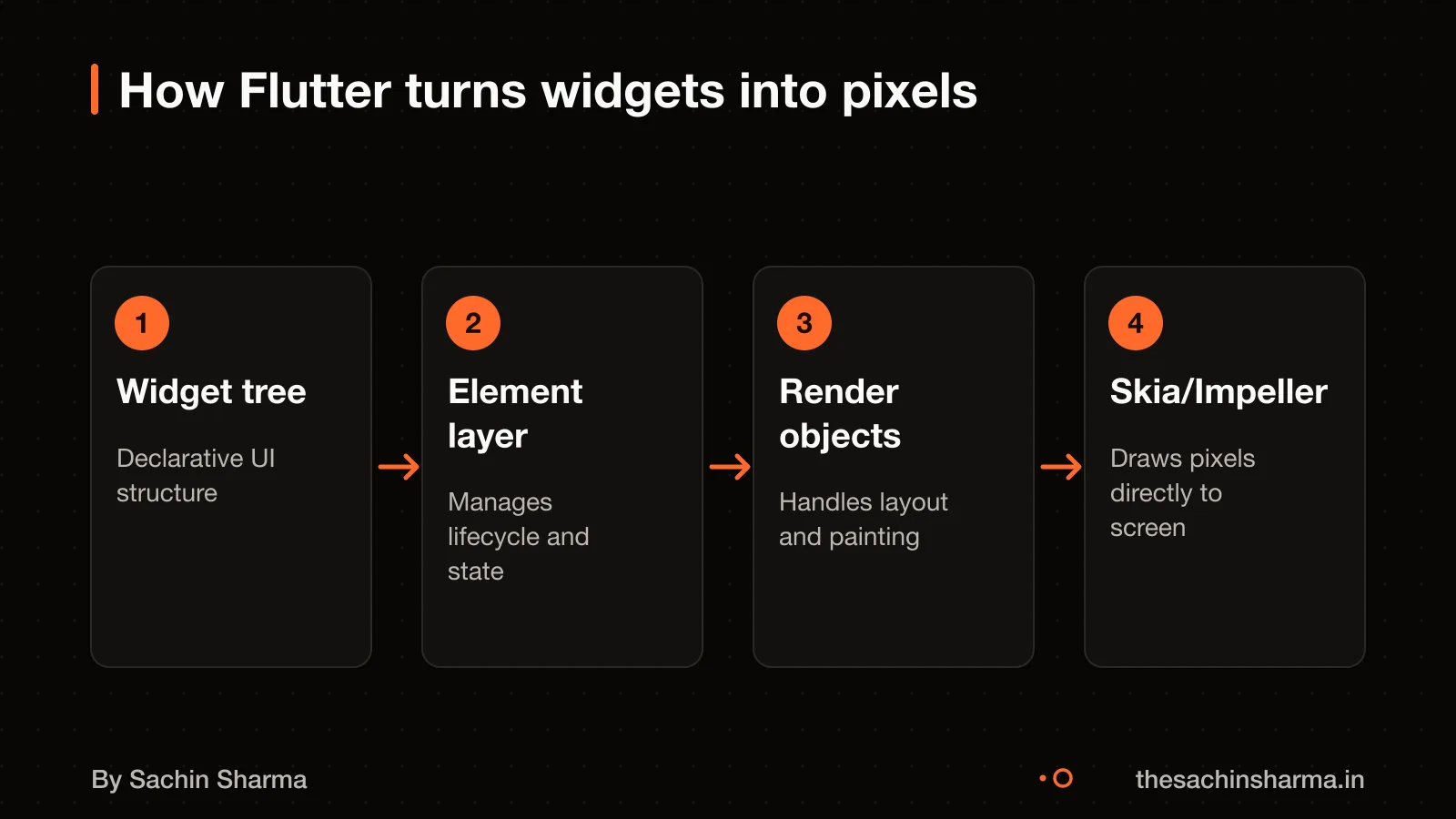
Flutter uses its own rendering engine, Impeller or Skia, to draw every pixel on screen. This means Flutter does not rely on the device’s native UI components. Instead, it builds the user interface from scratch using widgets, which are rendered into pixels by the engine. Elements connect these widgets to the rendering system, and render objects turn widget settings into actual drawing commands.
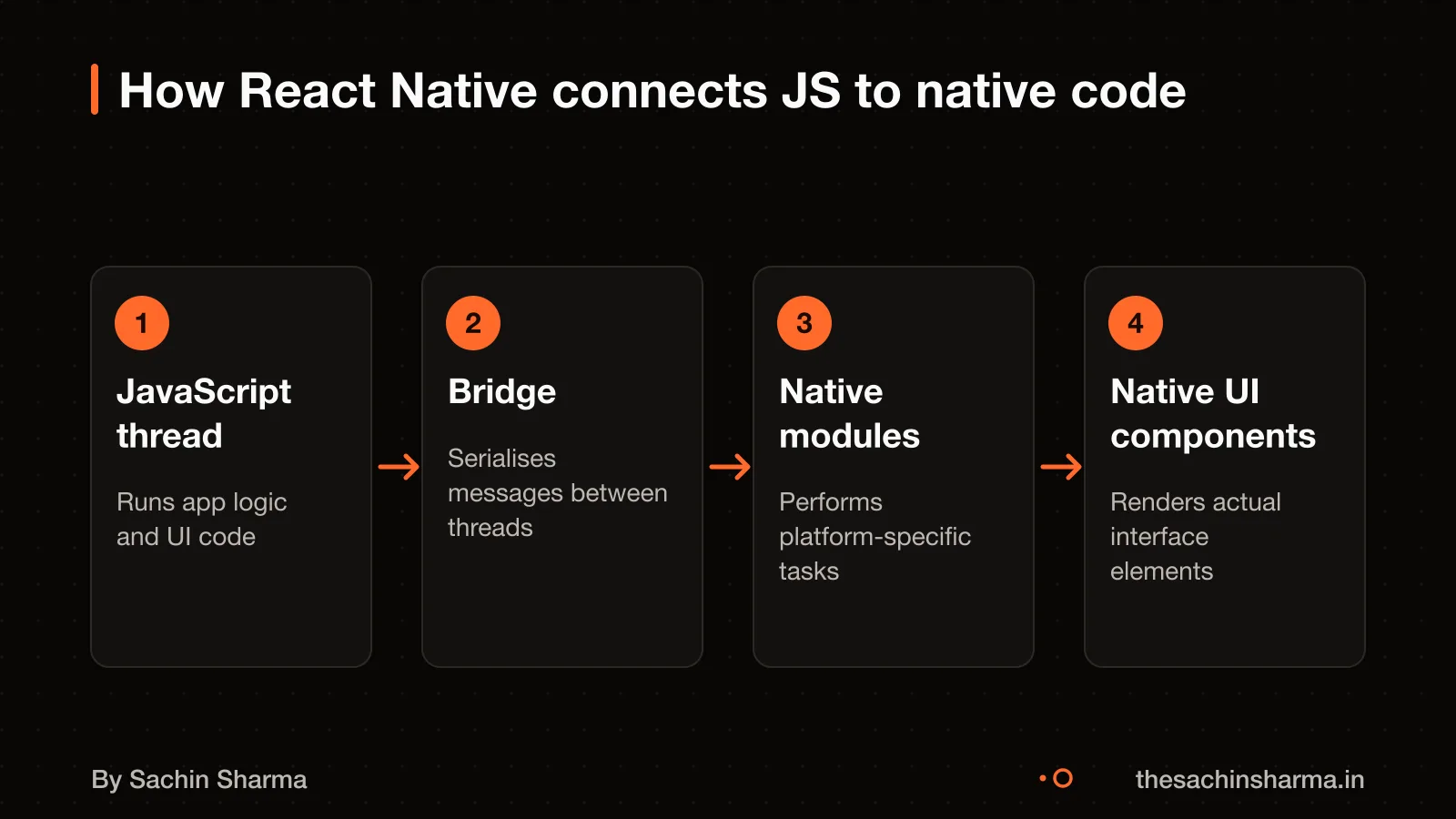
React Native works differently. It uses JavaScript to describe the app’s interface, but translates each component into the platform’s real native view. Such as a UIButton on iOS or a TextView on Android. This gives React Native apps a native look and feel. Communication between JavaScript and native code happens through a bridge, which can slow down performance during heavy or frequent calls.
Both frameworks can access native device features like the camera, GPS, biometrics, and Bluetooth. Flutter does this through platform channels or the Pigeon code generator, which lets Dart code safely call native code. React Native uses native modules and APIs exposed through the bridge. For most apps, the performance of both frameworks is now close to fully native apps, especially with Flutter’s compiled Dart code and modern optimisations.
Even though both are cross-platform, some apps still need fully native development. This is true for apps that use 3D graphics, augmented reality, or direct hardware control. For those cases, see when native is still needed.
Do you need a cross-platform app?
Yes, most business apps should use cross-platform tools. You can reuse 70% to 95% of the code across iOS and Android. This cuts total development cost by 30 to 40% compared to building two native apps. Over 40% of new mobile projects now use cross-platform frameworks. By 2026, cross-platform mobile development has become the default for about 90% of business apps. For example, my app Loopin uses one Flutter codebase for both platforms, with only minor tweaks for each OS. If your app does not need 3D, AR/VR or deep hardware access, cross-platform is likely the right choice.
when to choose native over cross-platform
Cost of Flutter vs React Native apps in India
An MVP in Flutter costs $5,000 to $15,000. A React Native MVP in India costs $5,000 to $13,000. A simple business app in Flutter ranges from $15,000 to $40,000. A mid-complexity React Native app in India costs $25,000 to $60,000. An enterprise app in India costs $60,000 to $150,000.
Hourly rates in India vary by experience. A junior Flutter developer charges ₹800 to ₹1,500 per hour. A mid-level Flutter developer bills ₹1,500 to ₹3,500, and a senior developer ₹3,500 to ₹7,000. For React Native, Indian developers charge $15 to $25 per hour at the junior level and $25 to $45 at the mid-level. Rates for senior React Native developers are not published.
These costs depend on the hiring model, team size, and app complexity. Freelancers may quote lower rates, but agencies often include design, testing, and project management.
The choice between Flutter and React Native does not decide the cost alone. Your app’s features, team structure, and long-term plans matter more. For example, a simple app with five screens and offline sync can cost under $10,000 if scoped tightly.
Want a number for your idea? Send one line on WhatsApp. I reply with what drives the cost and what to cut.
Message me on WhatsAppDevelopment time: Flutter vs React Native
An MVP in Flutter takes 2 to 4 weeks, while a full standard app takes 2 to 5 months. Flutter is faster for full builds due to stable performance and fewer bugs in later stages. However, React Native is faster to start because more JavaScript developers are available. For a solo founder or small team in India, this means you may get early prototypes quicker with React Native. But Flutter speeds up once the app grows.
For example, my app MojoPlay, a music app with real-time "Listen Together" sessions over a live socket. Mood-based discovery, background playback and offline downloads, took 10 weeks from concept to beta. It used Flutter’s hot reload and strong typing to avoid delays during testing. In contrast, a React Native app with similar features might find developers faster at first, but could slow down when fixing platform-specific bugs later.
The time to build depends on your team’s skill, not just the framework. If you hire freelancers, React Native may feel quicker at the start. If you build in-house or work closely with a developer, Flutter’s structure helps you move fast over time.
Which is better for a small team or solo founder?
React Native is faster to learn if you or your hires know JavaScript. But Flutter saves more in the long term if you plan to maintain the app for years. Around 42% of cross-platform developers prefer React Native. This makes it easier to find short-term help. React Native is also simpler to pick up for 67% of developers who already know JavaScript. However, Flutter’s single codebase and fewer platform-specific bugs reduce maintenance work later. This saves time and cost once the app is live and growing. If you are building alone or with one other developer and plan to keep improving the app, Flutter’s consistency can reduce technical debt. But if you need to ship fast and hire quickly on a tight budget, React Native may get you to market sooner.
What can go wrong in production?
Flutter controls the entire rendering layer, which allows teams to build pixel-consistent UI regardless of platform fragmentation or OS-level UI changes. This means your app’s UI stays consistent and responsive without relying on the device’s native components.
React Native apps, however, still face performance risks due to the JavaScript-to-native bridge. The top focus areas in 2026 include Bundle Size Optimization (88%), UI Thread Responsiveness (72%), and Memory Usage Reduction (65%). Large JavaScript bundles can delay app startup and hurt Time To Interactive (TTI), a key user-centric metric. If not managed, these issues lead to laggy screens and poor user retention.
Both frameworks require careful thread management. In React Native, long JavaScript tasks block the UI thread, causing delays when users tap buttons or scroll. Flutter avoids this by running Dart code directly on the UI thread, reducing bottlenecks. However, heavy computations in either framework can still freeze the interface unless moved to background isolates or native modules.
To catch problems early, React Native developers should profile the JavaScript and UI threads using Chrome DevTools or Flipper. Flutter teams can use DevTools to inspect frame rendering and isolate performance drops. Regular testing on low-RAM devices, common in India, is essential for both.
How to check if an app is well-built
A well-built Flutter app should aim for at least 80% code coverage. This means most of the code is checked automatically for bugs. Low coverage increases the risk of crashes and broken features.
It uses a feature-first structure, where files are grouped by feature (like `lib/features/auth`) instead of by type (like all widgets in one folder). This makes the app easier to update and scale. For example, all login-related code lives together, so one developer can work on it without touching unrelated files.
You can check quality using Flutter DevTools, the primary tool for diagnosing performance issues like slow rendering or memory leaks. Another option is the `flutter_quality_analyzer`, a Dart CLI tool that generates a health report for Flutter or Dart projects. These tools help you spot problems before users do.
Have a quote in hand? Send it to me and I will mark what is missing.
Message me on WhatsAppHow to verify a developer's work
Start by asking for client testimonials, as they can show how reliable and consistent a developer has been on past projects. These testimonials help you judge work ethic and communication style. Next, check credible third-party platforms for public reviews, which offer unbiased opinions about the developer’s quality and delivery. You can ask for code samples and performance metrics from past apps to verify a developer's work. This helps you see how clean the code is and whether the app ran smoothly on real devices. Every React commit is tested on business-critical surfaces with over a billion users. However, the final app’s quality still depends on the developer’s skill. Always review a live app they built, if possible, and test it yourself for lag or crashes.
Legal and tax rules for using Flutter or React Native
You must follow Indian law for your app’s content and data, not the framework. This includes rules under the Information Technology Act, 2000, and any sector-specific regulations like those for health or finance. The framework does not change your legal duties.
India Code is owned and operated by the Government of India, specifically the Legislative Department of the Ministry of Law and Justice. It was last updated on 13 October 2026. You can search and download any act from India Code. For state laws or recent notifications, check the respective state government portals or consult a legal professional.
Support and maintenance cost for each framework
Maintenance for Flutter apps may cost 15 to 20% of the initial development cost annually for updates and bug fixes. This lower cost comes from Flutter’s single codebase and stable widget layer, which reduce bugs and make updates faster across both platforms. Since Flutter renders its own UI components, it is less affected by OS-level changes, meaning fewer emergency fixes after iOS or Android updates.
Flutter’s maintenance savings are partly offset by a smaller talent pool in India. Making experienced Flutter developers slightly more expensive to hire than React Native ones. React Native’s larger community means more developers are available, especially at lower rates, and more third-party libraries exist to speed up fixes. However, React Native apps often face more integration issues due to reliance on native modules, increasing long-term debugging time.
For a founder planning to maintain the app for three or more years, Flutter’s predictable performance. Reduced need for platform-specific patches may save money despite higher initial hiring costs. If you expect to scale the team quickly, React Native’s wider talent base may still be an advantage. Especially for roles focused on rapid feature delivery.
Worked example: 5-screen MVP with offline sync
Worked example: 5-screen MVP with offline sync
As an estimate, a 5-screen MVP with offline sync and UPI payments costs ₹6.5 lakh over 12 months with Flutter. Annual maintenance is estimated at 15% to 20% of the build cost. Development takes 2 to 4 weeks for an MVP. The Flutter cost may be higher upfront due to a smaller, pricier talent pool.
As an estimate, the same app on React Native costs ₹6.0 lakh over 12 months. Initial development is $5,000 to $13,000. Assumption: $5,000 × 85 = ₹4.25 lakh. Timelines for an MVP are 4 to 8 weeks. Annual maintenance is assumed at 15-20%. This adds ₹0.9 to ₹1.2 lakh, based on annual maintenance of 15-20% of ₹6.0 lakh. If speed to market and hiring flexibility matter most, React Native is usually the more practical starting point for a startup. Long-term debugging and maintenance complexity may add costs.
Assumptions: 5 core screens, offline data sync, UPI integration, 12 months of maintenance at 15 to 20% of initial cost, and no major redesigns. Cost estimates are based on MVP pricing data from India and the U.S.. Assumption: data from U.S. dollar estimates converted at ₹85 per dollar. Currency conversion at ₹85 per dollar. Hidden costs for bug fixes, third-party services, or team changes are not included.
When this advice is wrong
React Native has a larger pool of developers in India, so you can often hire faster and cheaper at the start.
Native development is still better for apps that are 3D-heavy, use AR/VR, or depend on deep hardware integration. In these cases, neither Flutter nor React Native gives you full control, and performance may suffer.
If your team already knows one framework well, switching may cost more than it saves. Sticking with what your developers master reduces errors and speeds up delivery, even if the other tool has long-term benefits.
Related reading: when native is still needed, how hiring model affects cost, India Code.
Related reading: India Code, App or website first?, Best React Native developer in Raipur: how to choose, in 8 checks.
Next step: message me on WhatsApp with what you want to build. No forms, no sales team.
Message me on WhatsAppAssumptions behind the numbers
- App has 5 core screens and basic offline sync
- Team is based in India
- App is a standard business app, not hardware-heavy
- Need for native features is moderate
Pick your situation
I am a Flutter developer, so I benefit from choosing Flutter. The table below compares both options fairly using market data.
Pick your situation
Flutter wins. Flutter apps cost 15-20% annually to maintain, less than React Native's overhead from bridge and module updates.
The whole comparison
| Flutter | React Native | |
|---|---|---|
| Market share (2026) | 46% | 32% |
| Code sharing | 90–95% | 85–96% |
| Annual maintenance cost | 15–20% of dev cost | Higher due to bridge updates |
| Developer availability in India | Fewer, higher rates | More, lower rates |
| Performance on mid-range phones | Better (compiled code) | Good (with optimisation) |
| Best for | Polished UI, long-term apps | Fast MVP, quick hires |
Whichever you choose, ask these
- Can I switch later if I start with React Native?
- Will Flutter work if I need deep hardware access?
- What does the test coverage look like?
- How do I check if a library is well-maintained?
Questions people ask
01How do Flutter and React Native differ under load?
Flutter uses its Impeller engine to render frames predictably, reducing jank under load. React Native relies on JavaScript and native bridges, which can introduce complexity in performance-critical paths.
02What does it cost to migrate later?
Pick the right framework early based on your app’s needs.
03What fails first in production?
Flutter rendering has improved with Impeller. In React Native, performance can be affected by the JavaScript bridge or native modules, which are focus areas for optimisation. Monitor these areas in testing.
04Can I use UPI in both frameworks?
Yes, both Flutter and React Native support UPI payments. Flutter can use the Flutter UPI Bolt UI SDK. React Native can access native APIs through native modules. You will need a payment gateway that supports Indian UPI.
05Which has better tooling for Indian developers?
Flutter has tools like DevTools for performance checks and flutter_quality_analyzer for code health.
06Is Flutter harder to learn than React Native?
Flutter developers need to be experts in Dart, which takes most developers 3-4 weeks to feel comfortable with. React Native is easier if your team already knows JavaScript, as 67% of such developers find it easy to learn.
07Does app size matter for Indian users?
Yes, app size affects install and update rates, especially on low-end devices common in India. React Native apps often face more focus on bundle size optimisation, with 88% of teams working on it in 2026.
08What if my developer only knows one framework?
If your app needs Flutter but your developer knows only React Native, consider aligning team skills with product needs. Long-term fit matters more than short-term convenience.
09Can I mix native code with both?
Yes, both allow native code. Flutter uses platform channels or the Pigeon package to talk to native APIs. React Native uses native modules and bridges. This helps when you need device-specific features.