
What's in and out of the quote?
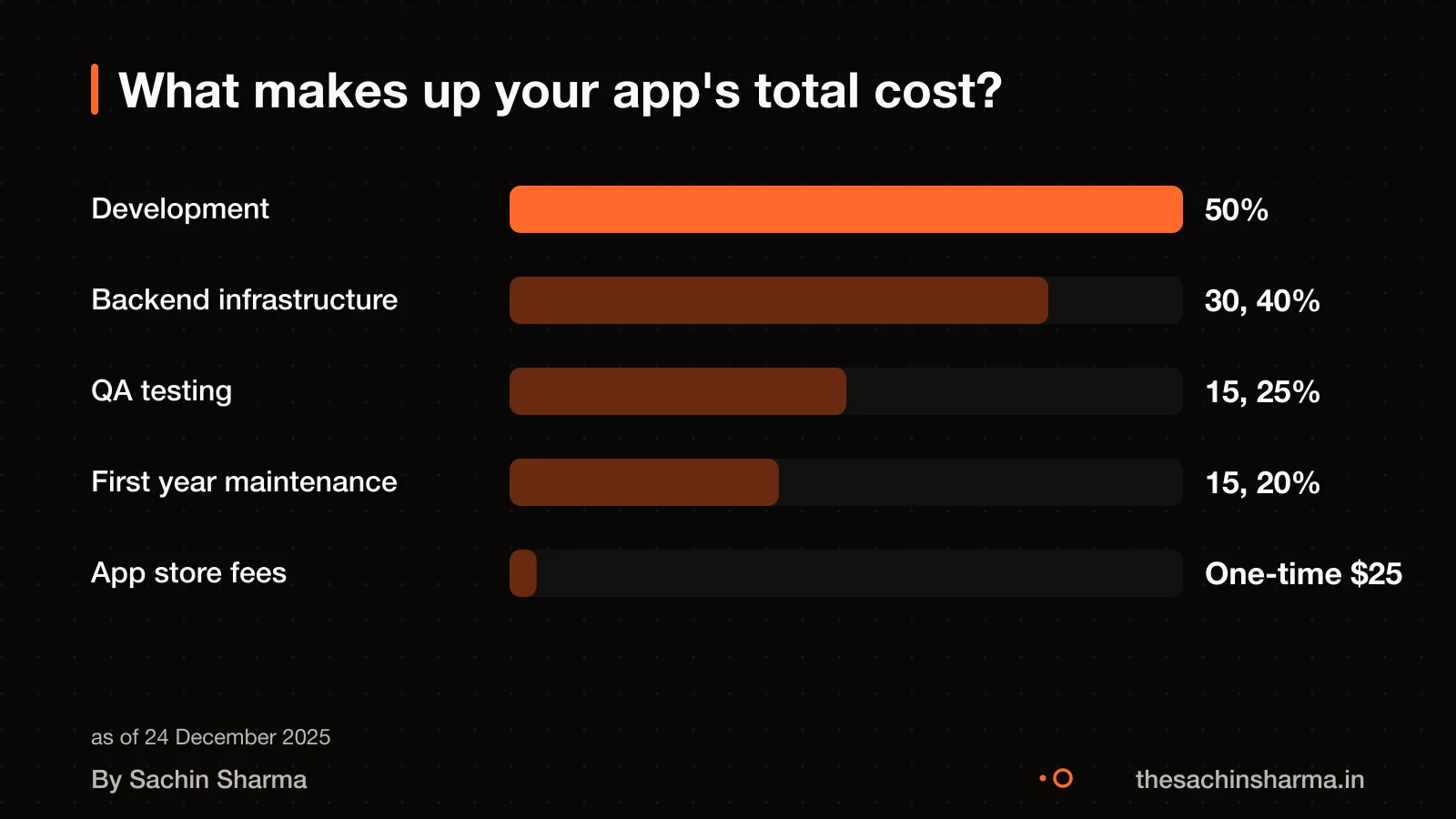
The real total cost of app development includes QA testing, cloud infrastructure, app store fees. Legal compliance, and at least the first year of maintenance. Core items in the quote should cover design, frontend, and basic backend work. But many quotes leave out QA testing, which takes 15 to 25% of a proper build. Backend systems can be 30 to 40% of the budget for complex apps.
Low quotes often skip QA, backend, or source-code ownership, always ask what’s excluded. Ongoing costs like updates and bug fixes are also not part of the initial estimate. That is why you should add 30 to 40% to your base development cost to cover QA testing. Infrastructure setup, and the first three months of post-launch maintenance.
How is app development cost calculated?
The total cost is the estimated hours multiplied by the blended hourly rate. For example, 600 hours at ₹2,500 per hour equals ₹15 lakh. This formula applies to most fixed-scope app projects in India.
Published cost ranges match app complexity. Simple apps cost ₹4 to 8 lakh. Moderately complex apps cost ₹8 to 15 lakh. Enterprise-grade apps cost ₹15 to 25 lakh or more.
Offshore development in India typically costs 40 to 70% less than hiring teams in the US for the same scope. This gap comes from lower operational costs and salary benchmarks, not lower quality. The savings apply only if project management and communication are handled well.
For example, a moderate app at 600 hours and ₹2,500/hr totals ₹15 lakh. This fits the ₹8 to 15 lakh range for such apps.
You may compare this to Website development cost in India if you are deciding between building an app or a website.
Want a number for your idea? Send one line on WhatsApp. I reply with what drives the cost and what to cut.
Message me on WhatsAppWhat factors increase app development cost?
Every new feature raises your app's cost more than you expect. This happens because each one adds not just build time but also testing and long-term maintenance. Costs grow non-linearly: an app with 20 features can cost 3 to 5 times more than one with 10, not double.
AI features increase cost because they require specialized engineering effort and resources. For example, turning voice notes into structured medical records (like in EHR Copilot) may take custom logic, data safety checks and extra testing.
Adding real-time features or compliance rules late can double or triple the cost. Fixing a finished app to meet GDPR-like data rules costs 2 to 3 times more than building them in from day one. The same applies to real-time sync or audit trails.
Building for both iOS and Android as separate native apps essentially doubles your cost. Cross-platform tools like Flutter or React Native can reduce that by 30 to 50 percent compared to two native apps. But the exact saving depends on your app’s complexity and team.
Each feature seems small at first. But it must be built, tested across devices, and updated for every change. That is why the real cost is in the total number of features, not just the big ones. Start with one platform and a narrow set of features to control cost.

How much does ongoing maintenance cost?
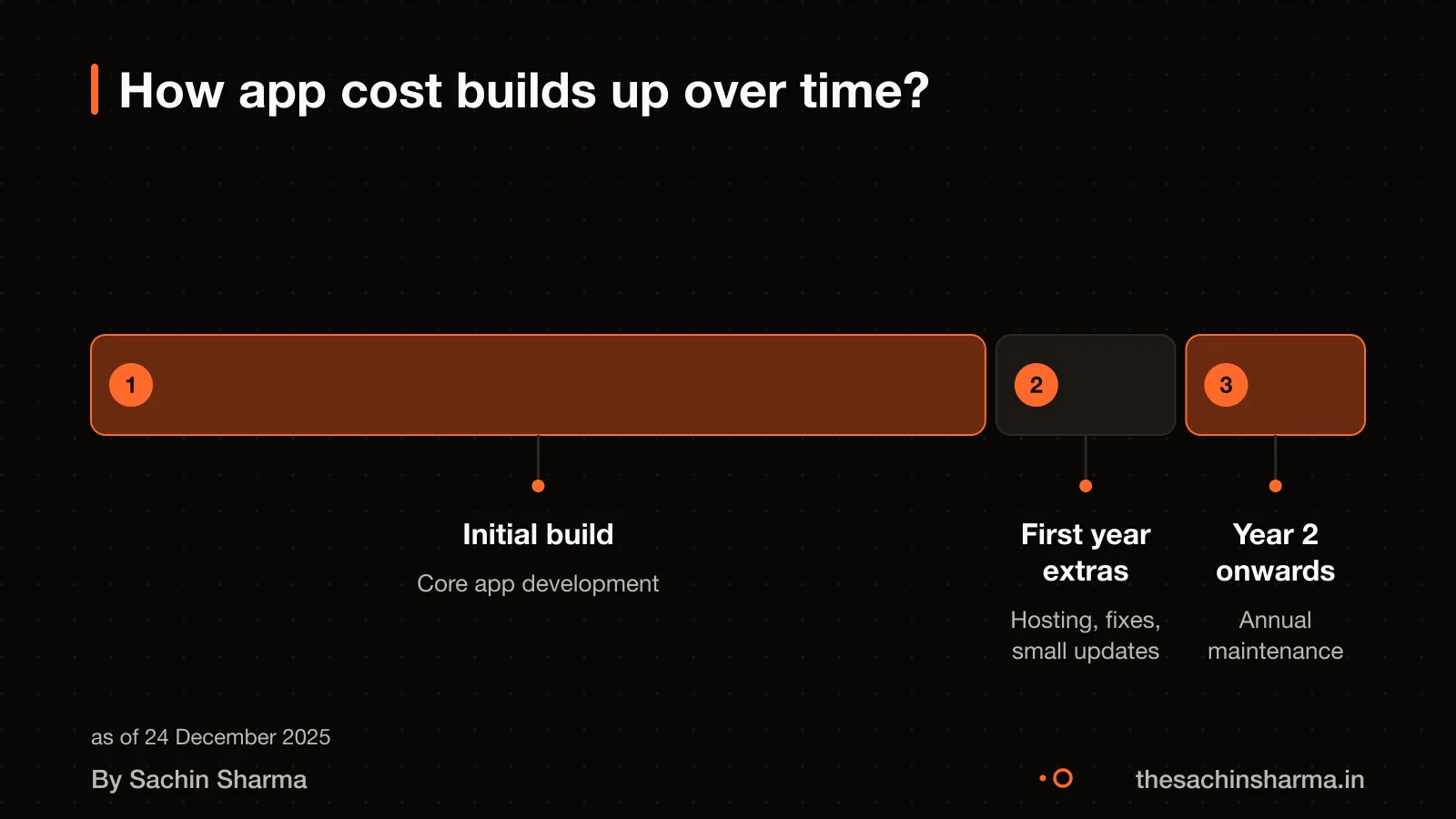
Plan for 15 to 20% of the initial build cost per year for maintenance. This covers bug fixes, operating system updates, and small feature additions. A quote that does not include this is incomplete because it hides long-term costs. For example, if your app costs ₹10 lakh to build, expect to pay 15 to 20% of that annually for maintenance.
Maintenance includes technical updates like new iOS or Android versions, security patches, and minor improvements. It does not usually include major new features, which are priced separately. Some agencies offer monthly plans from ₹5,000 to ₹25,000 for these tasks. Without maintenance, your app may stop working or become unsafe over time. Always ask for a breakdown of what the maintenance fee covers.
What third-party fees do I pay separately?
You pay extra for app store access, backend hosting, payment gateways and push notifications. These are not part of the development quote. The Google Play Developer Account costs $25 one-time, about ₹2,400, and is required to publish on Google Play. Backend hosting runs ₹1,000 to ₹15,000 per month, based on user count and data storage needs. For payment processing, expect a one-time integration cost of ₹5,000 to ₹15,000. A transaction fee of 2% per sale is charged by gateways like Razorpay or PhonePe. Push notifications are free for up to 10,000 users using Firebase, then cost ₹500 to ₹5,000 per month beyond that. These are recurring or one-time fees you must budget for after development.
What are the GST rules for app development?
Custom software development in India is taxed at 18% under SAC code 998311. This rate applies unless the service is exported and paid for in foreign exchange. If you are building an app for a client outside India and receive payment in foreign currency. You may qualify for 0% GST under export rules. To claim this, you must file a Letter of Undertaking (LUT) with the GST authorities. Without a valid LUT, you must pay Integrated GST (IGST) upfront, which can cause cash flow problems. For example, a ₹10 lakh project billed to a US client without LUT could require ₹1.8 lakh in IGST payment before refund. Always confirm your eligibility and file LUT on time. If you are unsure whether your project qualifies as an export, consult a GST practitioner for your specific case.
Who owns the code and accounts after build?
You own the source code only if your contract says so in writing. The contract should ensure the developer does not restrict or compromise intellectual property rights. This includes the app’s source code, design files and any custom tools built for your project.
You must control key accounts to run and update your app. These include the app store developer account (Google Play or Apple App Store), cloud hosting (like AWS or Firebase). Build pipelines (such as GitHub Actions or Bitrise), and analytics tools. For Apple, both the developer’s and your account must be active to transfer an app.
For example, if you later switch developers, you will need access to the Apple Developer Program to publish updates. Without it, your app cannot be maintained.
Can I get the source code of my app?
How can I verify a developer's estimate?
A realistic estimate starts with total hours and a blended hourly rate. What makes an estimate realistic is clear time tracking, defined scope, and inclusion of all key phases like design, development, testing, and backend work.
To check if a quote hides assumptions, look for wide ranges or missing items. A quote that says ₹5 lakh to ₹50 lakh may be too wide to plan with. If the quote does not list these, assume they are not included.
Red flags include vague timelines, no breakdown by phase, and promises of very fast delivery. Also watch for missing legal and compliance work, third-party tool costs, or hosting setup. A trustworthy quote lists both inclusions and exclusions.
Have a quote in hand? Send it to me and I will mark what is missing.
Message me on WhatsAppWorked example: cost of a moderate app
A moderate app may cost ₹8 to 15 lakh to develop. This assumes standard features like user login, profile management, and basic data sync without real-time or offline capabilities.
For quality assurance (QA), add 30 to 40% of the base cost. As an estimate, that is ₹4.5 lakh to ₹6 lakh. This covers test planning, device testing, bug reporting, and retesting after fixes.
This depends on user count, data storage, and traffic. As an estimate, assume ₹1 lakh per year for a growing user base.
Annual maintenance costs are typically 15 to 20% of the initial build cost. As an estimate, that is ₹2.25 lakh to ₹3 lakh per year. This includes updates for new OS versions, minor bug fixes, and small feature tweaks.
The total first-year cost, including base development, QA, hosting, and maintenance, comes to an estimated ₹21.87 lakh to ₹25.8 lakh. This assumes no major scope changes or unexpected delays.
Assumptions in this estimate: - 600 hours of effort at ₹2,500 per hour - 30 to 40% added for QA and launch prep - ₹1 lakh per year for hosting - 15 to 20% annual maintenance - No third-party fees for payment gateways or push notifications included - No real-time, offline, or AI features added
When this advice is wrong
When this advice is wrong for you:
This advice is for small business apps with simple needs. It does not apply if your app must meet strict compliance rules. Building GDPR-ready data handling from the start costs less than adding it later. If you need real-time tracking, multiple user roles or audit logs, the work grows fast. Each role needs its own view, access checks and test cases. These features often require a more experienced team and longer testing. For such cases, a basic quote will not be enough.
Related reading: How to hire a developer in India.
Next step: message me on WhatsApp with what you want to build. No forms, no sales team.
Message me on WhatsAppAssumptions behind the numbers
- Assumed blended developer rate: ₹2,500/hour
- Hidden cost buffer: 30–40%
- Cross-platform saves 30–50% over native
- Late scope changes increase cost by 2–3x
Work out your own number
I won't hand you a number that pretends to be the market. Instead, here is the working: set the weeks, the people and the rate, and see where the money goes.
Your working total
₹4,40,00011 weeks × 2 people × 5 days × ₹4,000- Scope and design18%
- Build55%
- Testing and fixes18%
- Launch and stores9%
The weeks shown are an example of a small app, there to be changed. Fees you pay others (store accounts, cloud, SMS) are not in this total.
What moves the price
- AI features
Specialized effort and resources increase cost.
- Real-time features
Live tracking and chat need more design and testing.
- Native apps for iOS and Android
Two separate codebases double the effort.
- Cross-platform (Flutter or React Native)
One codebase cuts cost by 30–50%.
- Managed backend services
Removes weeks of custom backend work.
- Changing scope mid-build
Late changes cost 2–3x more.
Fees that go to someone else
Google Play developer account
A one-time fee of about ₹2,400.
Apple Developer Program
A yearly fee of about ₹7,000.
Cloud, SMS, maps, payments
Usage-based, billed monthly.
Ask for these before you sign
- How many weeks per phase, and with how many people?
- What is not included?
- Which fees do I pay to others directly?
- What happens to the price when I change my mind?
- What does the first month after launch cost?
Questions people ask
01How do real-time features like chat or tracking affect cost?
The cost impact of adding real-time features like chat or tracking late is not known [unknowns]. This is because they require changes to the app's core structure, extra testing, and ongoing server resources. As a proxy, adding GDPR-ready data handling late also costs two to three times more.
02What happens to the app after launch?
After launch, your app needs bug fixes, updates for new operating systems, new features, and hosting upkeep. Maintenance costs ₹5,000 to ₹25,000 per month for bug fixes, OS updates, and feature additions.
03How do third-party API integrations affect cost?
Each third-party API integration adds setup time, error handling, and long-term maintenance. More APIs increase complexity and testing effort. This can raise the overall cost.
04Can I move my app to another developer later?
Yes, you can move your app to another developer if you own the source code and have admin access to all accounts. Both the source and destination app store accounts must be active. For example, Apple requires both developer accounts to be active for a transfer.
05How do compliance needs like HIPAA affect cost?
The cost impact of adding HIPAA compliance late is not known [unknowns]. It requires secure architecture, audit trails, and documentation.
06How much does offline sync add to app cost?
The exact cost of offline sync is not known. However, it increases complexity and testing time because data must be stored locally and synced reliably when the network returns. Ask your developer for a separate line item for this feature.
07What are the cheapest ways to cut app cost without losing value?
Start with one platform instead of two. Use managed backend services like Firebase. Cut non-core features and define a clear scope early. While exact savings are not known, a tight scope avoids costly mid-project changes.
08What are common ways app cost estimates go wrong?
Quotes often go wrong when they are too wide or leave out key items like QA, hosting, or maintenance. One agency might quote $30,000, another $300,000, and both could be right. Always ask what is not included in the estimate.
09How can I get an accurate quote for my app?
Write a clear brief with must-have features, target platforms, and needed integrations. Ask for a line-item quote that breaks down design, development, and testing. A detailed brief helps developers give a more accurate number.
10Who controls the app store and hosting accounts?
You should have full admin access to app store and hosting accounts. This includes cloud environments, build pipelines, and analytics tools. Verify ownership early to avoid losing control later.